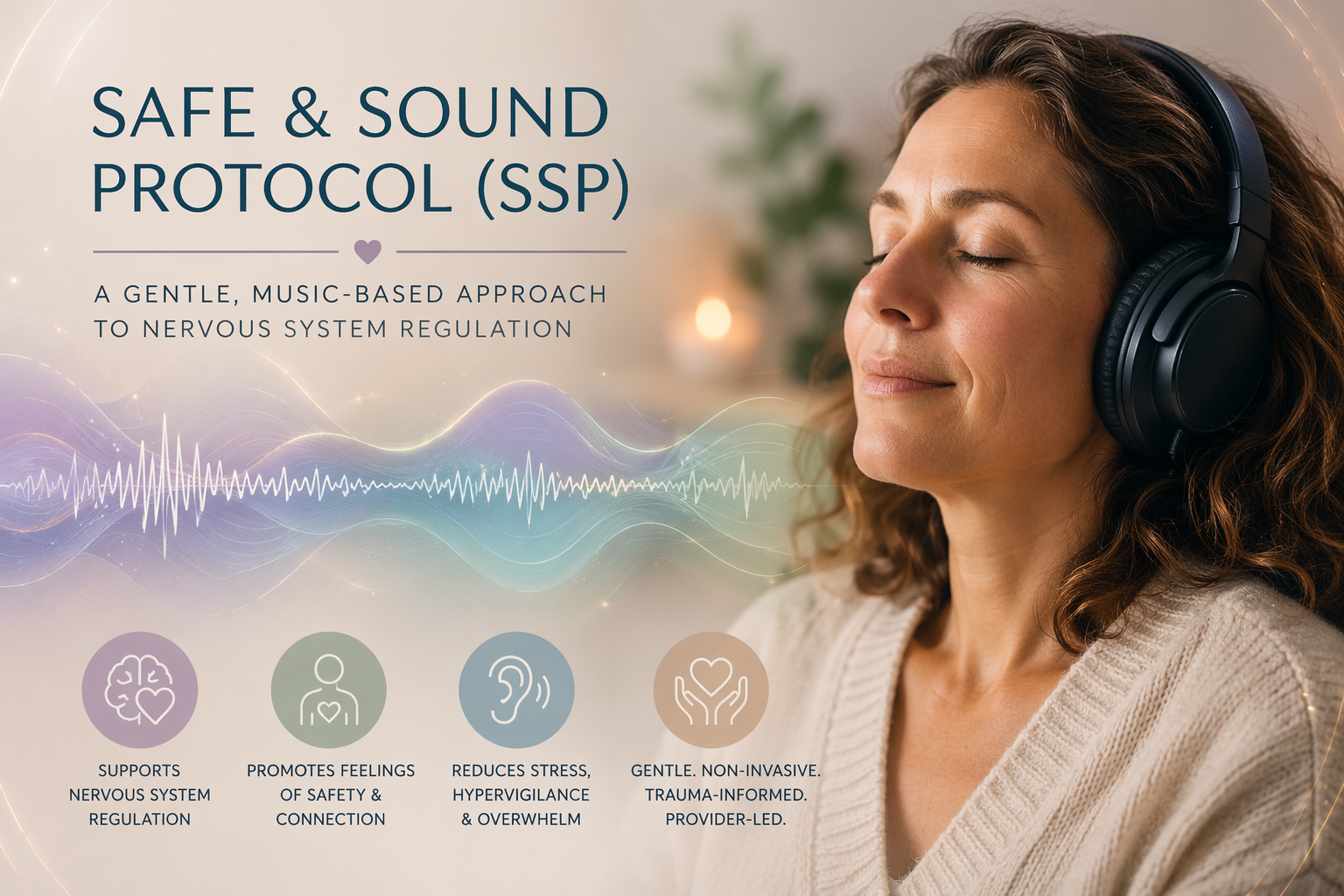
If you live with anxiety, overwhelm, hypervigilance, shutdown, or the feeling that your body never quite settles, you may have come across the Safe and Sound Protocol, often shortened to SSP.
The Safe and Sound Protocol is a music-based listening intervention developed by Dr Stephen Porges, creator of Polyvagal Theory. It uses specially filtered music and is designed to support nervous system regulation, reduce auditory sensitivity, and enhance social engagement. It is delivered by trained providers and is typically used alongside wider therapeutic support rather than as a stand-alone cure or quick fix.
I am currently completing my training in the Safe and Sound Protocol and will be offering it soon in Bath, Somerset, and online. I wanted to write this post because SSP is often described in very short or very technical ways, and many people are left wondering what it actually is, how it works, and whether it might be relevant for them.
What is the Safe and Sound Protocol?
The Safe and Sound Protocol is a non-invasive listening therapy that uses specially filtered music delivered through headphones. According to Unyte, the company that delivers SSP training and technology, it is designed to help shift the nervous system from defensive states toward regulation, so that people can feel safer and connect more easily with others.
The protocol was developed by Dr Stephen Porges from research that led to Polyvagal Theory. In simple terms, Polyvagal Theory explores how the autonomic nervous system responds to cues of safety and danger, and how those responses shape our capacity for connection, rest, regulation, protection, and survival.
SSP focuses especially on the auditory system. The filtered music emphasizes frequencies in the range of the human voice, with the aim of helping the nervous system detect cues of safety more accurately. Unyte describes this as training the auditory system to better recognize voice frequencies and respond with greater regulation and social engagement.
Why listening?
When a person has lived through trauma, chronic stress, or long periods of overwhelm, the nervous system can become biased toward danger. This can affect far more than mood. It can shape how the body responds to sound, social interaction, facial expression, tone of voice, and even quiet everyday environments. Unyte’s overview of SSP explains that the intervention is intended to support people whose bodies remain stuck in chronic defense, including patterns of hypervigilance, withdrawal, and difficulty connecting.
In this framework, listening is not just about hearing sound. It is connected to how the body evaluates safety. SSP was designed to work through that pathway by offering repeated, carefully filtered auditory input.
What does SSP help with?
This is where it is important to be both hopeful and honest.
SSP is commonly used by clinicians as an adjunctive intervention to support nervous system regulation, auditory sensitivity, emotional regulation, and social engagement. Unyte describes it as being used by therapists, mental health professionals, and sensory practitioners to help clients regulate their nervous systems and become more receptive to therapy.
People often explore SSP when they are experiencing things like anxiety, chronic stress, hypervigilance, shutdown, sensory sensitivity, difficulty settling, or challenges with connection.
That said, SSP is not a guarantee, not a one-size-fits-all approach, and not something I would describe as a miracle intervention. The most responsible way to talk about it is that it may support regulation and create better conditions for therapeutic work, depending on the person, their history, their sensitivity, and how the protocol is paced and held. This is also why trained delivery matters.
Is there evidence for SSP?
There is a growing evidence base around SSP and its earlier form, the Listening Project Protocol, though the research is still developing and not all studies are large or definitive.
Unyte describes SSP as an evidence-based intervention and has published real-world outcomes and white papers summarising clinician and client reports.
A 2023 exploratory pilot study in adults with autism spectrum disorder reported improvements in some measures including social awareness and reductions in some autistic traits after SSP, though the study was small and exploratory, so its findings should be interpreted carefully rather than as proof for broad claims.
Unyte’s 2024 white paper also describes SSP as a non-invasive acoustic vagal nerve stimulator designed to regulate the autonomic nervous system and complement other therapies, but because this white paper is produced by the company behind SSP, I would treat it as a useful source for understanding the model and intended application rather than neutral proof of effectiveness.
So the honest summary is this: the theory is influential, the clinical enthusiasm is strong, and the early evidence is promising, but SSP should still be spoken about carefully and without exaggeration.
What does an SSP session actually look like?
SSP is delivered through specially filtered music listened to on headphones, usually over a series of sessions. Official SSP guidance explains that the full protocol involves five hours of music, but the pace and structure can vary depending on the individual and the provider’s judgment.
A good SSP process is not just “press play and hope for the best.” It is relational, paced, and responsive.
In practice, this usually means the provider is paying close attention to how much listening is tolerable, what happens in the body before, during, and after listening, and how to support regulation and integration around the process. Official SSP materials emphasise what to expect from a provider and the importance of staying informed throughout the listening journey.
For some people, listening may feel subtle. For others, it may bring up fatigue, emotion, agitation, or body sensations that need careful pacing. That is one reason trained support matters so much.
Why SSP fits with my wider approach
What draws me to SSP is that it speaks the same language as the rest of my work.
My background is rooted in trauma-informed, body-based practice. I work with Core Process Psychotherapy, Somatic Experiencing®, and Conscious Connected Breathwork. What these approaches share is a respect for pacing, nervous system wisdom, embodiment, and the understanding that healing is not something we force.
SSP feels like another doorway into this work.
For some people, talking is not the place to start. For some, the system needs more support around safety and regulation before deeper therapeutic processing becomes possible. Unyte explicitly presents SSP as a therapy-supporting intervention that can enhance receptivity to other modalities.
That is how I hold it too: not as a replacement for relationship, presence, or attuned therapeutic work, but as a gentle support that may help create the conditions for that work to land more deeply.
Who might be curious about SSP?
You may feel drawn to learn more about SSP if you:
- feel chronically on edge or unable to settle
- find it hard to move out of anxiety or hypervigilance
- experience shutdown, numbness, or disconnection
- are sensitive to sound, noise, or social environments
- want support for nervous system regulation alongside therapy or somatic work
These are not promises or guarantees. They are simply some of the patterns for which SSP is commonly explored in practice and official provider materials.
A note on safety, expectations, and pacing
I think it is important to say this clearly: nervous system work should not be sold as a magic answer.
SSP may be supportive for many people, but it is still a therapeutic intervention. It needs to be introduced with care, and it may not be right for everyone at every moment. Good practice means considering readiness, pacing, support, and integration rather than assuming more is better.
I am currently completing my SSP training, so at this stage I am sharing information and building this into my work with care. Once I begin offering it, it will be in a way that is trauma-informed, gradual, and responsive to each person’s nervous system.
Safe and Sound Protocol in Bath, Somerset, and Online
I offer the Safe and Sound Protocol in Bath, Somerset, and online.
This will sit alongside my wider practice of Core Process Psychotherapy, Somatic Experiencing®, and Conscious Connected Breathwork, and will be offered with the same attention to gentleness, pacing, and embodied safety.
If you are curious about SSP and would like to hear when spaces open, you are welcome to get in touch and register your interest.
Healing does not begin in force. It begins in safety. Sometimes that safety is found through words. Sometimes through breath. Sometimes through the body being gently shown that it does not have to stay braced against the world.
SSP is one more way of listening for that.