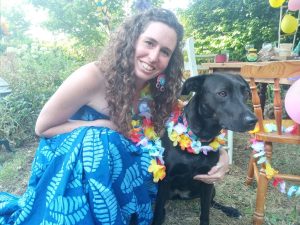
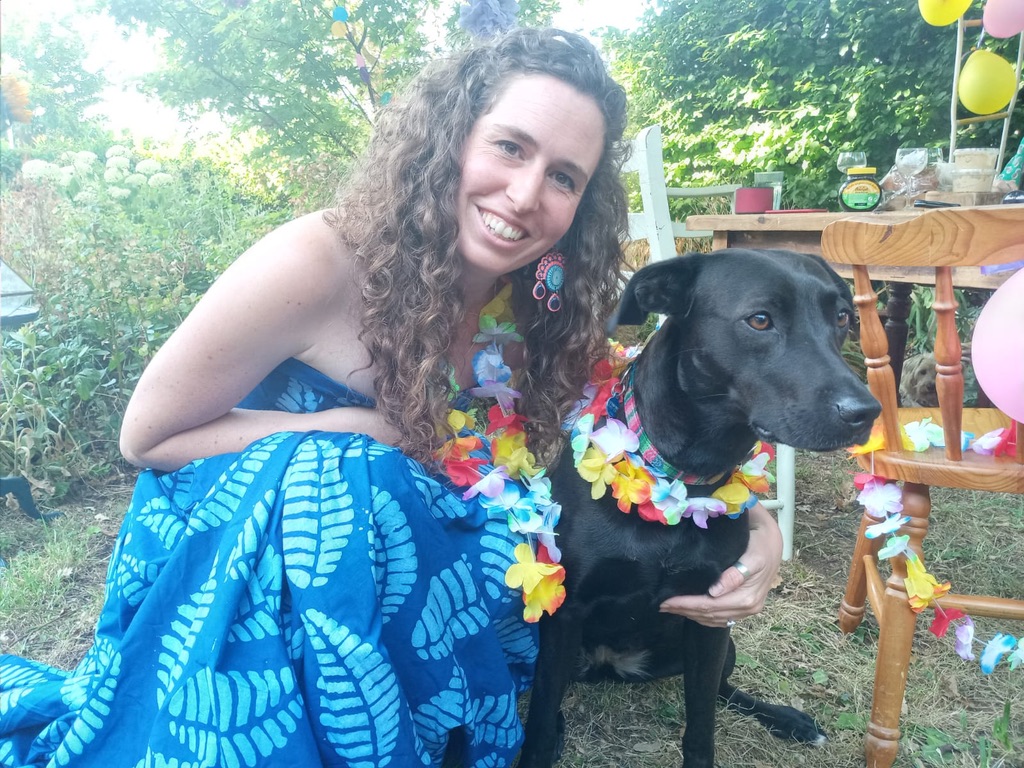
Some dogs enter your life quietly.
Others arrive like a storm.
Nessi was both.
The Puppy Nobody Thought Would Survive
Years ago, I found a litter of puppies advertised on Gumtree. They were from a much-loved family dog called Coco — a cross between a whippet and a staffie — and the father was a friends Labrador.
My husband Jonny called the woman selling them, but by the time he rang, she apologised and explained that all the puppies had already found homes.
Jonny, being Jonny, carried on chatting to her anyway.
At the end of the conversation, she paused and said:
“Well… there is one. But we don’t think she’ll make it. She was the runt of the litter and she’s much smaller than the rest.”
Jonny replied instantly:
“If she survives, she’s ours.”
And she did survive.
Not only did she survive — she thrived.
The tiny puppy we were warned might not make it grew into a strong, intelligent, beautiful dog, eventually just as big as the rest of the litter. So when the time came, we brought her home.
And life became wonderfully chaotic.
Living With a Highly Sensitive Dog
Nessi was never what you’d call an “easy” puppy.
Of course, most puppies are a handful. But there was something different about her nervous system from the beginning. The whippet sensitivity, the stress around her early beginnings, perhaps even the experience of being the runt — whatever the reasons, Nessi moved through the world with a kind of hypervigilance.
I remember my sister-in-law once saying to me:
“Well Beth, to be honest, I couldn’t have handled a Nessi.”
Their Labrador puppy had been calm, easy-going, and naturally settled in the world.
Nessi was not that dog.
She struggled with separation anxiety. Jonny and I both cared deeply about helping her, though we often had very different ideas about what the “right” approach was. Jonny rarely approached things in conventional ways…
Despite her challenges, Nessi adored training. She was bright, eager, connected, and deeply bonded to us both. She became a wonderful companion.
But underneath that, there was always an activated nervous system.
She never truly relaxed in other people’s homes — even familiar homes, with people she had known for years. She wouldn’t let many people touch her head. And while she could be affectionate and loving with us, she rarely was with others, even if she was happy to see them and it was always entirely on her terms.
This was not a naturally cuddly dog.
This was a dog living with hypervigilance.
When Trauma Changes a Dog
Then life happened.
We experienced a prolonged trauma in our personal lives — the kind of trauma that slowly saturates a household, affecting every nervous system within it.
Around the same time, Nessi had an unfortunate encounter with a reactive dog.
Then another.
And another.
Gradually, she became reactive too.
Soon, every walk felt stressful. There were fights with other dogs daily. Her nervous system seemed permanently braced for danger.
I became overwhelmed. Frozen, in many ways. I knew I should reach out for support, but I couldn’t fully access the energy or clarity to do it. I think many people living with chronic stress or trauma know that feeling — when even asking for help feels beyond reach.
Discovering the Safe and Sound Protocol (SSP)
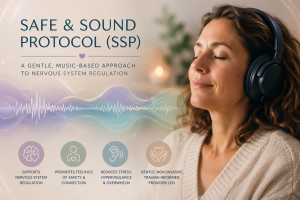
Around this time, I began working with the Safe and Sound Protocol (SSP).
The SSP is a listening therapy developed by Dr. Stephen Porges, based on Polyvagal Theory. It uses specially filtered music to support nervous system regulation and help the body move out of chronic states of defence.
As someone working in the world of trauma, somatics, and nervous system healing, I was deeply curious about it.
But I never imagined what would happen next.
In one session with my therapist, I was talking about Nessi and describing her anxiety, hypervigilance, and reactivity.
My therapist gently suggested something unexpected:
“What if Nessi listened too?”
Importantly, this was done in titrated, carefully supported conditions with professional guidance. I would never recommend anybody try SSP with their dog without working alongside a trained SSP practitioner.
So Nessi listened.
Over time, she completed the five hours of the protocol.
And she became a different dog.
The Changes We Saw in Nessi After SSP
The changes weren’t subtle.
The dog who had once reacted aggressively toward other dogs on nearly every walk stopped fighting, now she walks slowly and carefully past dogs that she feels might be reactive.
The dog who would scream and whine in the car out of fear of being left behind became calm when arriving somewhere new.
The dog who couldn’t settle in other people’s homes began relaxing, sleeping, and resting in unfamiliar spaces.
The dog who wouldn’t let people touch her head started allowing more human connection and physical affection.
And perhaps most importantly, she seemed safer in herself.
Not shut down.
Not obedient.
Not “trained out” of behaviour.
But regulated.
As though her nervous system no longer believed the world was constantly dangerous.
Dog Reactivity and the Nervous System
I think we often misunderstand reactive dogs.
We frame them as behavioural problems rather than nervous systems stuck in survival states.
Many reactive dogs are not “bad” dogs.
They are overwhelmed dogs.
Hyper-alert dogs.
Dogs whose systems have learned that the world is unpredictable, unsafe, or threatening.
And just as trauma affects humans physiologically, I believe it affects animals too.
Nervous systems adapt for survival.
The beautiful thing is: nervous systems can also heal.
Why I Decided to Train in SSP
My own experiences with SSP profoundly changed me.
But witnessing the transformation in Nessi brought something into even sharper focus.
Healing is not always cognitive.
Sometimes safety must first be felt in the body.
Watching Nessi soften, settle, connect, and rest convinced me deeply of the power of this work.
And honestly, it became part of the reason I decided to train in this modality myself.
Because when you witness a being move from chronic vigilance into genuine safety, it changes the way you understand healing forever.
Final Thoughts
Nessi will probably always be a sensitive dog.
I don’t think SSP erased her temperament, nor would I want it to.
Sensitivity is not pathology.
But there is a profound difference between sensitivity and survival.
One allows connection.
The other braces against the world.
Watching her nervous system slowly discover safety has been one of the most moving experiences of my life.
And perhaps that’s true for all of us — human or animal.
Sometimes beneath the reactivity, beneath the anxiety, beneath the guarding and vigilance, there is simply a nervous system waiting to learn that it no longer has to fight so hard to survive.
Interested in Nervous System Healing?
I work with nervous system regulation, Somatic Experiencing, breathwork, and the Safe and Sound Protocol (SSP), supporting people experiencing anxiety, overwhelm, trauma, hypervigilance, and chronic stress.
I offer sessions in Bath, Somerset and online.
If this resonates with you, you are welcome to get in touch.